
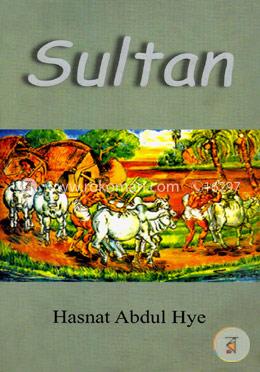
Sultan

ABOUT
THE BOOK
Sultan subsumes elements of biography, art criticism and socio-cultural history. The central character is S.M Sultan, a living Bangladeshi artist. The writer himself is a character in the novel and suggests that the book is a novel about writing a novel.
Original title in Bengali Sultan published by University Press Ltd (1991)
ABOUT
THE TRANSLATOR Kabir
Chowdhury
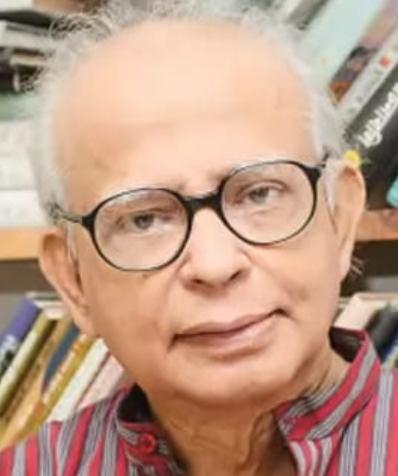
Kabir Chowdhury (Bangla: কবীর চৌধুরী) was a well-known academic, essayist, materialist, translator, cultural worker, civil society activist and a pioneer in the movement against fundamentalism in Bangladesh. He’s the brother of Munier Choudhury.
Kabir grew up in an atmosphere of liberal ideas and secular thinking. When he studied English literature in Dhaka University in the early 1940s he was greatly impressed by the writings of H.G. Wells, George Bernard Shaw and Bertrand Russell, among others. During the second World War he was deeply troubled by the Nazi atrocities carried out in their concentration camps, the mass killing of Jews as a plan of ethnic cleansing and the destruction of all democratic norms. Kabir’s faith in democracy, secularism and liberal thoughts grew stronger by the day and he found himself drawn to socialist ideology.
He has written extensively on world’s famous writers and painters. He has also written extensively on peace and conflict resolution through discussion and has tried to promote these values by his work as a teacher and as an administrator. He was inducted as National Professor of Bangladesh in 1998. He was the chairman of the Advisory Council of Ekatturer Ghatak Dalal Nirmul Committee (Committee for Resisting the Killers and Collaborators of 1971). In all the above capacities he has significantly contributed to the dissemination of secular ideas and democratic values. His ideology is materialism. He has written extensively on anti-fundamentalism, religious fanaticism and communalism, and has stressed the need for developing broad human values and for realizing the importance of cultural diversity, and the imperatives for developing a pluralistic society. Professor Chowdhury played a leading role in many movements in Bangladesh, especially in the anti-communal movement, movement to establish democracy, and significantly in the movement to ensure the trial of those who had committed crimes against humanity and war crimes during the War of Liberation of Bangladesh in 1971.
Kabir Chowdhury (Bangla: কবীর চৌধুরী) was a well-known academic, essayist, materialist, translator, cultural worker, civil society activist and a pioneer in the movement against fundamentalism in Bangladesh. He’s the brother of Munier Choudhury.
Kabir grew up in an atmosphere of liberal ideas and secular thinking. When he studied English literature in Dhaka University in the early 1940s he was greatly impressed by the writings of H.G. Wells, George Bernard Shaw and Bertrand Russell, among others. During the second World War he was deeply troubled by the Nazi atrocities carried out in their concentration camps, the mass killing of Jews as a plan of ethnic cleansing and the destruction of all democratic norms. Kabir’s faith in democracy, secularism and liberal thoughts grew stronger by the day and he found himself drawn to socialist ideology.
He has written extensively on world’s famous writers and painters. He has also written extensively on peace and conflict resolution through discussion and has tried to promote these values by his work as a teacher and as an administrator. He was inducted as National Professor of Bangladesh in 1998. He was the chairman of the Advisory Council of Ekatturer Ghatak Dalal Nirmul Committee (Committee for Resisting the Killers and Collaborators of 1971). In all the above capacities he has significantly contributed to the dissemination of secular ideas and democratic values. His ideology is materialism. He has written extensively on anti-fundamentalism, religious fanaticism and communalism, and has stressed the need for developing broad human values and for realizing the importance of cultural diversity, and the imperatives for developing a pluralistic society. Professor Chowdhury played a leading role in many movements in Bangladesh, especially in the anti-communal movement, movement to establish democracy, and significantly in the movement to ensure the trial of those who had committed crimes against humanity and war crimes during the War of Liberation of Bangladesh in 1971.