
Lázar

ABOUT
THE BOOK
The Lázárs have ruled their Hungarian lands for generations. In their ancient castle by the edge of a forest that compels all who enter it to madness, they succumb to every vice and live only to satiate their desires. But the old order is crumbling, and the days of the Habsburg Monarchy are numbered. When Lajos von Lázár inherits, they at last have a baron who can reignite the old splendours, but not even his abilities are proof against the ravages of war and occupation. It will fall to his children – a boy who talks to shadows and a girl who eschews her blue blood – to find a way to stand against oppression and take the first faltering steps towards freedom.
Original title in German Lázár, published by Rowohlt Berlin (2025)


ABOUT
THE TRANSLATOR Jamie
Bulloch
Jamie Bulloch has translated almost fifty books from German, including works by Timur Vermes, Robert Menasse, Sebastian Fitzek and Daniela Krien
Jamie Bulloch has translated almost fifty books from German, including works by Timur Vermes, Robert Menasse, Sebastian Fitzek and Daniela Krien
NOMINATING LIBRARY COMMENTS
Somewhere in Hungary at the beginning of the 20th Century. The aristocratic family Lázár lives in a Forest Castle. From the times of the fin de siècle over the two World Wars and the takeover of Eastern Europe by the Soviet Union, Nelio Biedermann unfurls the history of his own family. Interspersed by fairytale-like atmospheres the novel highlights masterfully what it means to lose your home, your hope and your love when you become uprooted. It’s incredible that an author that young is capable of writing this good. Or in the words of Daniel Kehlmann: “A truly great writer steps onto the stage”. (Leipziger Städtische Bibliotheken)
As the 70th anniversary of the 1956 Revolution approaches, the novel takes on particular relevance; its plot spans from the early 20th century to the suppression of the revolution and the family’s flight. At the center of the story are the Barons of Lázár, whose lives unfold in a mysterious „forest castle” (Waldschloss) in southern Hungary and in the palaces of Budapest. This family saga, spanning generations, is both a historical tableau and a psychological drama interwoven with elements of magical realism. Critical reception has highlighted the author’s poetic language, which displays a maturity beyond his years. The German press (NZZ, Die Zeit) compares the book to Thomas Mann’s Buddenbrooks because of its depiction of the decline of the bourgeoisie and nobility; at the same time, Gabriel García Márquez’s magical realism is a frequent point of reference due to the book’s ominous, Gothic atmosphere and the subtle weaving of supernatural elements. The plot begins with the birth of Lajos von Lázár, whose fate is intertwined with the collapse of the Monarchy, the world wars, and the rise of communism. The novel is not a dry historical chronicle, but a story of desires, secrets, and silences. Nelio Biedermann was born in Zurich in 2003 and is currently pursuing his university studies there. Lázár is his second novel, but it was this one that marked his breakthrough. His choice of subject matter is no coincidence: the author’s paternal grandparents were Hungarian aristocrats who fled to Switzerland in 1956. Biedermann drew on family lore but enriched it with fictional elements. (Katona József Könyvtár)
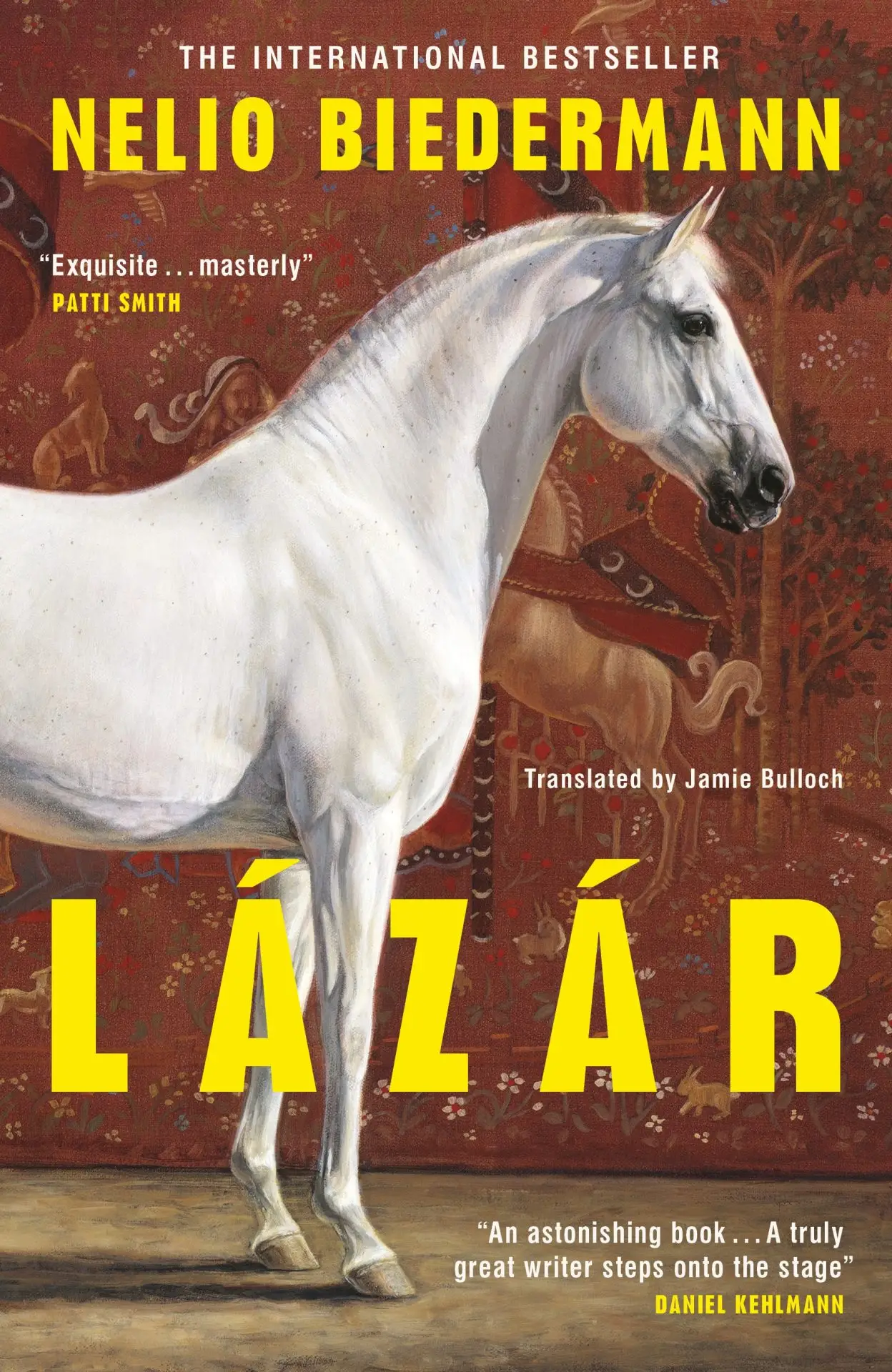
Lázár by the Swiss author Nelio Biedermann is a true favourite among readers of the Bruges Public Library. The sweeping family chronicle is an impressive debut that reads like a grand European novel. Biedermann launches the novel with the birth of Lajos von Lázár, the “transparent child with water-blue eyes.” The tone is set for the introduction of his eccentric ancestors inspired by the stories of his grandmother. The Hungarian aristocratic family lives in a remote castle on the edge of a dark, mysterious forest. Biedermann creates an almost fairy tale-like atmosphere. The family members are beautifully drawn, each with their own peculiarities and extraordinary traits. They are vivid, tragic and infused with a subtle touch of magical realism. The mother of Lajos, for instance, spends years training herself in the art of lying, allowing her to conceal her affair with the stable hand with professional ease. This adds an extra touch of playfulness to the striking cover featuring the white horse, a central figure in Hungarian mythology. There is Uncle Imre, who slowly succumbs to his obsession with the eerie tales from Hoffmann’s Nachtstücke, increasingly retreating into his own literary world. The novel is full of literary references, to writers such as Proust, Kafka, Gogol, and Dostoevsky. This adds an extra dimension to the whole and makes it even more enjoyable to read. What stands out most is Biedermann’s exceptional narrative power. His novel is brimming with literary virtuosity and imagination. He has a keen eye for detail and offers beautifully crafted nature descriptions. Above all, he excels in a rich style, writing long, winding sentences that nevertheless remain fluid and light footed. At the same time, the novel contains a subtle, restrained humour. The atmosphere is equally strong. The novel unfolds against the backdrop of the wars and revolutions of the twentieth century. The threat of war and the Russian Revolution forces the aristocratic family into exile, giving Lázár a clear political dimension. All of this makes Lázár a remarkable debut. It is the work of a promising and stylistically confident author. Lázár is a refreshing read, giving full rein to imagination once again. (Openbare Bibliotheek Brugge)
In his novel „Lázár“, inspired by his own family’s history, Swiss author Nelio Biedermann paints a richly layered panorama of the decline of a Hungarian aristocratic family. Spanning the period from the fin de siècle to the Cold War, the novel moves from provincial Hungary to the vibrant imperial capital of Vienna. It follows Baron Sándor von Lázár and the fortunes of his family through the upheavals and catastrophes of twentieth-century history. The novel powerfully intertwines the fate of one family with the history of Europe. (Stadtbibliothek Bremen)
This novel is a literary sensation not only due to the author’s young age. Nelio Biedermann grippingly writes about the decay of an aristocratic Hungarian family. He brillantly interweaves the protagonists’ experiences with the political unrests that Hungary has experienced from the Habsburg Empire to the 1950s and the post-war Soviet rule. The chosen setting as well as the author’s literary style evolve a haunting atmosphere laced with elements of magical realism. An immersive reading-experience! (Stadtbücherei Heidelberg)