

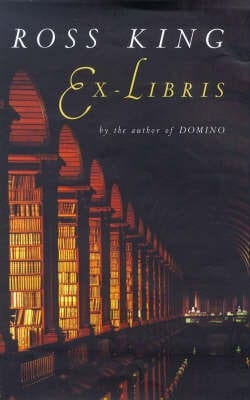
Ex Libris

ABOUT
THE BOOK
Responding to a cryptic summons to a remote country house, London bookseller Isaac Inchbold finds himself responsible for restoring a magnificent library pillaged during the English Civil War, and in the process slipping from the surface of 1660s London into an underworld of spies and smugglers, ciphers and forgeries. As he assembles the fragments of a complex historical mystery, Inchbold learns how Sir Ambrose Plessington, founder of the library, escaped from Bohemia on the eve of the Thirty Years War with plunder from the Imperial Library. Inchbold’s hunt for one of these stolen volumes – a lost Hermetic text – soon casts him into an elaborate intrigue; his fortunes hang on the discovery of the missing manuscript but his search reveals that the elusive volume is not what it seems and he has been made an unwitting player in a treacherous game.

NOMINATING LIBRARY COMMENTS
“Ex-Libris, by Ross King – review:
I knew very little about The Thirty Years Wars (1620- 1648), except that it began in earnest as a religious struggle between Catholics and Protestants and developed into a European struggle for power, which eventually saw the decline of the Spanish Empire.
Ross King’s novel, Ex-Libris, focuses on the 1660s, after those wars, but in a parallel narrative he links events in the 1660s with those of the initial outbreak of the great wars, in Bohemia, in 1620. In the 1660s, Isaac Inchbold, an elderly bibliophilic London bookseller, is intrigued to be summoned to a Dorset mansion where he is shown a vast , dilapidated, yet valuable library and is commissioned by the apparent owner, a pipe-smoking lady of consequence, to search his booktrade contacts for a copy of an obscure Hermetic text known as The Labyrinth of the World. (He is not “responsible for restoring a magnificent library” as the IMPAC Newsletter of January 2000 declares).
He accepts the commission, but during an inspection of the mansions’ library, he finds a coded message inserted into a copy of a famous atlas by Ortelius and he steals it. From this time onwards, his searches through the world of London booksellers is dogged by mysterious followers, and danger to his quiet life becomes very apparent.
On this level, the novel is a mystery story, with dangers, false clues, and a variety of exciting incidents, which Inchbold relates in person. The parallel narrative reverts to the events at the outbreak of the Wars in 1620, in which we follow the progress of the rescue of the library of the Bohemian Court from Prague to England, under the protection of a strange Englishman , Sir Ambrose Pennington, a collector of books and antiquities for many courts of Europe, who had once sailed with Raleigh on his ill-fated expedition up the River Orinoco to find El Dorado.
We are initially convinced that poor Inchbold’s dangerous sufferings are related to the pursuit by agents of the King of Spain to capture the missing heretical and Hermetical manuscript, but gradually, the secrets of navigation are revealed as a greater threat than heretical lost texts to Spanish domination and empire , To say more, would be to spoil this intriguing story for readers. What must be said is that the book entertains on a number of levels, but that it is no “easy read”.
At one level, one enjoys the excitement and intrigue of the mystery from old Inchbold’s point of view. At another we can boggle at the wealth of knowledge of historical bibliography of the period. At another , we can learn something of the obscure history of the Bohemian phase of the 30 Years Wars, and, at yet another ,we are introduced to the concepts of Hermetic beliefs, and also to the importance of astronomical developments in the temporal and religious power struggles of the era.
An unforgettable read, with wonderful portraits of Inchbold and of his 17th century London, with its bustle, noises and smells. The book also drives you to the encyclopaedia, to relearn more of the Thirty Years Wars, and , it must be said, to the dictionary, to ascertain the meanings of the many obscure words the author employs in telling his fascinating story.”